The Gifts of The Air
“Stop thinking, and end your problems.”~ Lao Tzu.
We are now in a time of air, with Gemini birthdays in full swing.
So, this week let’s look at the gifts of the spirit of air, how are the playful Sylphs moving through at the moment?
Remember, you can draw a card to place on top of one here that draws you in, or perhaps you know your Decan position, the following, then, make for good meditation/contemplation prompts.
Swords are the element of air. Thoughts are like birds of the air. Sometimes the thoughts glide on a summery breeze, sometimes they swoop on a churning current. At other times they merely fly in and out of the tree swaying in the wind.
Sword symbolism is a case for the intellect, mental processes and streams of consciousness.
The Sword also represents sharp incisiveness, ideas and communication, alongside cutting cords of outworn thought processes and mental cycles.
It doesn’t take a giant leap of the imagination to imagine an airy sylph wandering in the clouds.
A sylph (also called sylphid) is an air spirit stemming from the 16th-century works of Paracelsus, who describes sylphs as (invisible) beings of the air, his elementals of air. A significant number of subsequent literary and occult works have been inspired by Paracelsus’s concept: Robert Alfred Vaughan noted that “the wild but poetical fantasies” of Paracelsus had probably exercised a larger influence over his age and the subsequent one than is generally supposed, particularly on the Rosicrucians, but that through the 18th century they had become reduced to “machinery for the playwright” and “opera figurantes with wings of gauze and spangles”.
The Swiss German physician and alchemist Paracelsus first coined the term sylph in the 16th century to describe an air spirit in his overarching scheme of elemental spirits associated with the four Classical elements. Paracelsus drew from earlier sources, but his systematic treatment of the idea was definitive, with the names of three of the four types having originated in his works. The other three elemental spirits named were Gnomes (earth), Salamanders (fire), and Undines (water). These ideas were adopted in Rosicrucianism and were widely encountered in subsequent hermetic literature.
We understand that AE Waite was a Rosicrucian; Paracelsus’s ideas about elementals were fundamental in the symbolism of the RWS deck. It was undoubtedly a platform for Waite to express his esoteric knowledge.
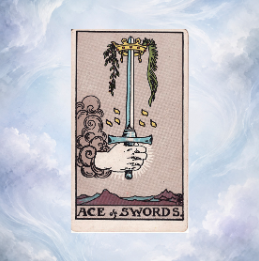
Ace of Swords
The spirit of the Ace is pure and truthful, liberating all at once.
The essence is not comfortable illusion, but shining clarity.
It’s the thought that can’t be unthought. A knowing.
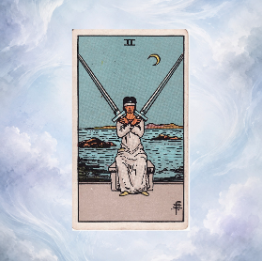
The Two of Swords
The spirit here desires peace and balance. It holds two opposing truths apart to avoid an implosion.
The essence is, dignity amidst chosen blindness. She lives to think another day.
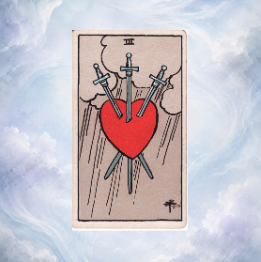
The Three of Swords
The spirit of this card is almost sacred. It validates the suffering that is undertaken in order to understand the nature of love.
The essence is the acknowledgement of grief that will bring relief.
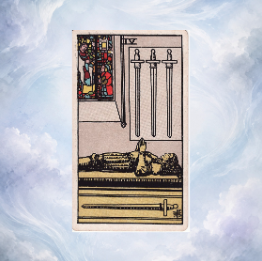
The Four of Swords
The gift of this spirit is like that of a warrior.
It understands that rest is not weakness, it’s strategy.
The essence is, the intelligence of stillness.
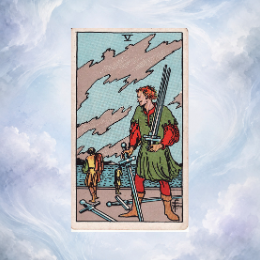
The Five of Swords
This is another warrior, getting the rewards by whatever means.
The essence is, the war was lost but the battle was won.
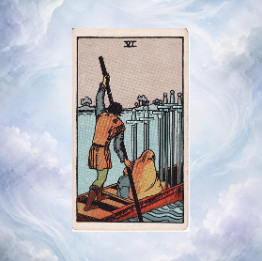
The Six of Swords
This spirit is nomadic, becoming static is not an option.
The essence is, I will leave behind the struggle and trust what is to be on the other side.
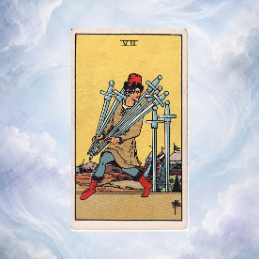
The Seven of Swords
The gift of this spirit that permission is not always required. To be unafraid to live with oneself.
The essence is, there is a part of you that survives because it remains unseen.
The Trickster can be a useful ally.
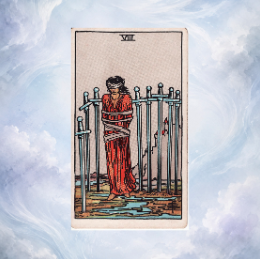
The Eight of Swords
Here the spirit seeks freedom. Internal blindfolds wait to be removed.
There is always a choice, to walk or not to walk, to see or not to see.
The essence is, the prison is made of our own certainties, adventure lies in the courage to face what is to come.
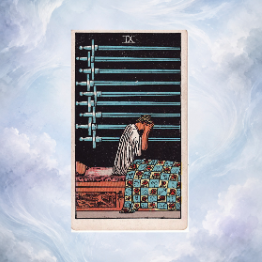
The Nine of Swords
Spirit becomes relatable. The thoughts have become bigger than the situation. The divine sits at the centre of it all. The courage to live with one’s own mind.
The essence is, spirit is a constant companion, especially through the lessons of learning to love who we are and what we have become.
The Ten of Swords
The gift is in endings. Safely through the worst, the horizon is calling.
Spirit brings a strange peace, what has gone does not have to return.
The essence is, a total ending. The opportunity presents itself for one to be completely themselves.
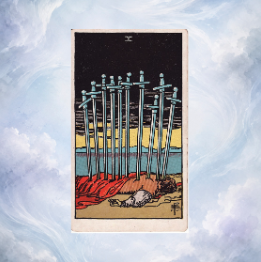
This is the story of thriving.
The ace forces the knowing.
The two refuses it.
The three receives it as grief.
The four rests from it.
The five corrupts it.
The six carries it into new territory.
The seven tries to outsmart it.
The eight is imprisoned by it.
The nine is tormented by it.
The ten is finally and undeniably floored by it
And survives it to thrive….
I would love to hear your thoughts on this in our Exploring Tarot Facebook Group
With love,