“Sometimes at pagan shrines they vowed
Seamus Heaney, Beowulf.
offerings to idols, swore oaths that the killer of souls might come to their aid and save the people. That was their way, their heathenish hope; deep in their hearts they remembered hell.”
St. Patrick and the Hierophant
March 17th. A truly auspicious date in the calendar, and if I may say, quite relevant in this day and age of fear of invasions, apostasy and the fall of governments, dynasties and cultures. If there was ever a time that needed a legend it’s perhaps, now!
All hail St. Patrick.
I must say that for very many years, despite having close friends that were of Irish descent and very patriotic, I didn’t really look in any depth at the story of St. Patrick. I associated his day with an unwritten law of wearing green and enjoying a good libation and generally having the good old craic.
Religion, has not been a fulfilling feature in my life and St. Patrick represented so much of what had put me off any kind of religiosity. Patriarchy, authoritarian rule and the repression of an underdog.
However, as another year looms around I took another look at this enigmatic and enduring character. I associated him with the Hierophant and his connection to faith and belief.
The Shamrock.
Where would St. Patrick’s day be without a Shamrock? It’s three leaves reflect the Holy Trinity or Tri-unity. This search for unity is the reason Pagans were either converted to the one God or slaughtered, this kind of unified culture made life a lot easier for those that were in charge. Yet, at it’s deeper level, Holy Trinity speaks of God alive in mankind and also in the world, or rather the spirit of the world, being the church. Deep reflection on the divine source, in each of us, doing it’s work through us is very engaging. If we are of service, then this may encourage personal pathworking and belief structures.
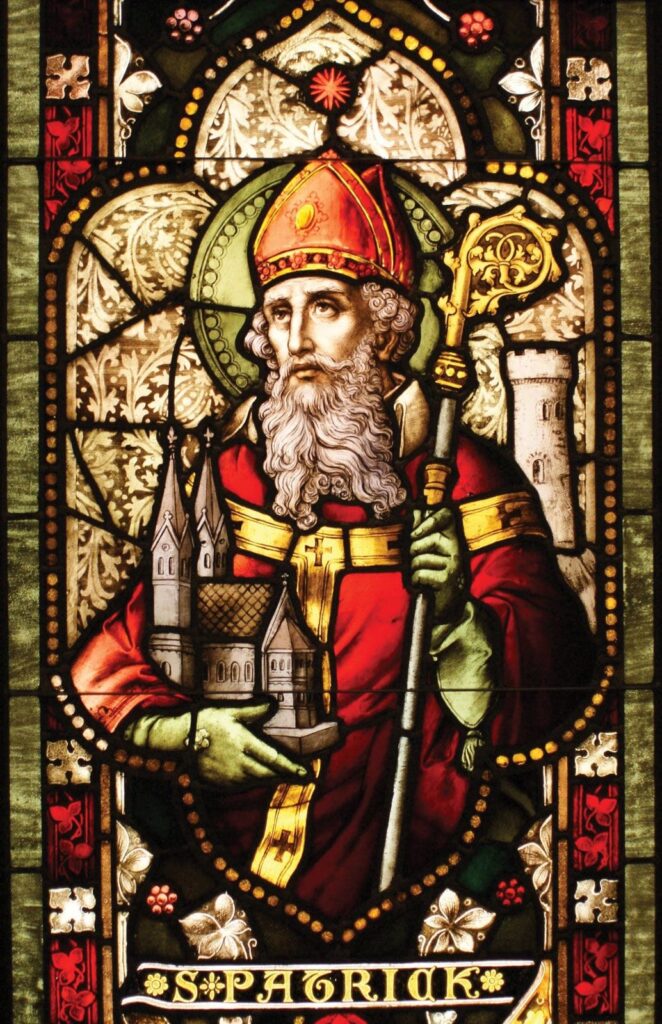
St. Patrick
(flourished 5th century, Britain and Ireland; feast day March 17). He is credited with bringing Chritianity to Ireland and was probably responsible in part for the Christianization of the Picts and Anglo-Saxons.
Patrick was born in Britain of a Romanized family. When he was 16 years old, Irish raiders tore him from the villa of his father, Calpurnius, a deacon and minor local official, and carried Patrick into slavery in Ireland. He spent six bleak years there as a herdsman, during which time he turned with fervor to his faith.
Upon dreaming that the ship in which he was to escape was ready, he fled his enslaver and found passage to Britain. There he came near to starvation and suffered a second brief captivity before he was reunited with his family.
Careful to deal fairly with the Celtic tribes,
he nevertheless lived in constant danger of martyrdom. The evocation of such incidents of what he called his “laborious episcopate” was his reply to a charge—to his great grief, endorsed by his ecclesiastical superiors in Britain—that he had originally sought office for the sake of office. In fact, he was a humble-minded man, pouring forth a continuous paean of thanks to his Maker for having chosen him as the instrument whereby multitudes who had worshipped “idols and unclean things” had become “the people of God.”
Before the end of the 7th century, Patrick had become a legendary figure, and the legends have continued to grow. One of these would have it that he drove the snakes of Ireland into the sea to their destruction. Patrick himself wrote that he raised people from the dead, and a 12th-century hagiography places this number at 33 men, some of whom are said to have been deceased for many years. He also reportedly prayed for the provision of food for hungry sailors traveling by land through a desolate area, and a herd of swine miraculously appeared.
He is certainly a legend.
There is something about faith, a faith that is a resource and a way of life, not quite hermit, not quite papal, but nevertheless, a person who truly believed in his purpose and the enactment of the divine will.
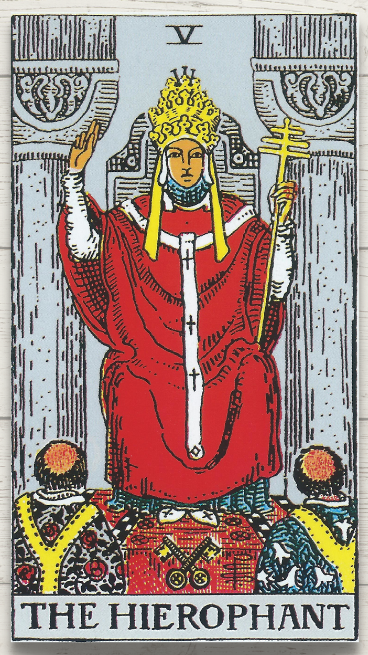
Faith is a word that I associate with The Hierophant.
This card speaks of bringing a harmony into your relationship with the physical world and the realm of spirit.
Everyone has their own path, their own understanding of the divine, that part is unique, yet it is held together by societal norms. We should tread carefully amongst the dogma and the tradition. Our spirtual development is unique unto the self.
The Hierophant indicates divine inspiration. What is your spiritual heritage?
How are you connected to the culture you live in and the Earth you walk on?
What is the message that we carry forth from our forebears?
MEDITATION PROMPTS FOR TIMES OF SPIRITUAL STAGNANCY
- What personal or familial traditions are you hanging onto that prevent you from expressing your faith?
- Is there an imbalance in your attitude or lifestyle?
- Are your core beliefs too rigid?
- Do your material concerns outweigh your spiritual ones?
- Have you given up on society and wish to live in the margins?
These are just some questions that you may find yourself asking from time to time. The natural world is calling you. That place of beauty that is not tarnished by the drudgery and misunderstandings of the everyday world.
The Forest, field or hedgerow is the real church. It is there that we are reminded that spirit of an intelligent love is in all things.
| Come and share your thoughts on St. Patrick and The Hierophant in my private Facebook group, it’s a safe space to explore and discuss tarot. |