“It’s hard enough to give fearlessly, and it’s even harder to receive fearlessly.
Amanda Palmer, The Art of Asking; or, How I Learned to Stop Worrying and Let People Help.
But within that exchange lies the hardest thing of all:
To ask. Without shame.
And to accept the help that people offer.
Not to force them.
Just to let them.”
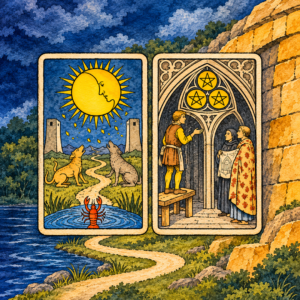
The Six of Pentacles
I used to have people come to my home for a reading. That all came to an end with Covid and, in all honesty, I am not unhappy with that. The rhythm of my life has changed a bit, the way I fit consultations into my schedule is now smoother and efficient! Perhaps that seems all rather cold and clinical, after all,sittings should be warm, friendly and empowering. However, I’d like to think that I achieve that no matter what way I choose to perform a consultation.
such an interesting card. It sits in the Southwest position, aligns with Archangel Uriel, Ruled by Mercury, is a mineral and connects to Quartz. It embodies sensation and is the Elder Brother! (Gnostic Tarot, Lee Irwin).
Actually, what brought this card to mind was that it is time again to get one’s affairs in order and sort out the travel tickets and dinner receipts for the tax man! I may well tut-tut as I do so, but at least I can be happy in the knowledge that my payment covers some of the services that I use on a usual basis, and probably take a bit for granted. Fair exchange is no robbery…although when it comes to the institutions this could be a debatable point!
The Six of Pentacles, like so many other cards, is multifaceted.
We see a well dressed figure dispensing coins with one hand and holding scales with the other. Kneeling before him are two figures who, with outstretched hands, as if they are meant to be in such a posture, readily receive the money.
The sixes are curious as in each of the cards the imagery is dominated by a larger figure. The other characters are smaller, as if they are playing smaller but important roles. The dominant figure could indeed be a representation of our higher/wiser self. The wiser self, in a nutshell, is compassionate, benevolent, understanding and brings resolution to conflict. So many internal debates have been lost and won with regards as to how active this wiser being within is allowed to be.

In the Waite Smith deck we could ask, who is the giver? If the larger figure is the Higher self, then the two kneeling figures are the lower aspects of our being. They are the opposing factors that struggle for reconciliation, they are the base self searching for refinement and elevation. They are the mirror image of the wealthy one, yet it is this figure that is seemingly attending to the needs of the poorer one. From a Gnostic perspective, they are a creation of each other. Without each other there would be no completion or fulfilment. In this six, we are witnessing the laws of reciprocity. We see support, conviviality, awareness of needs, charity, all of which start at home. Without being able to love the pauper and the beggar within, we wouldn’t develop the compassion to understand the same process in another.
On a more mundane level, this six reminds us to keep our heart open,
to share willingly and to love freely. We are invited to build a healthy relationship with money and objects. To value what we have and not to squander. Lack of prudence can reflect innermost feelings about one’s spirit or path in life.
Yet, we are also advised about being too generous. Are our motives for generosity generated by the need for advancement, do we play with false friendships to protect our own needs?
What is our view of charity? Is it a drain, a burden, someone else’s problem? Do we secretly despise the automated action of the institution to offer succour to the less fortunate?
Do we adhere to a society where there is a deserving poor and the rest are going to hell in a handcart? And all the while, our own inner creatures lie abandoned and loveless.
There but for the grace of God, Go I, or something like that anyway.
So, apart from alerting us to a better financial time, the money go round turning in our favour and to be generous enough but at the same time have boundaries… What else?
The Six of Pentacles can give us a nudge in the direction of diversity,
that the world has inhabited margins and that most of us function with an outward face.
I am not sure if we can achieve being classless and free, does it even exist? This six takes us beyond the illusory perceptions of a social strata. We can awaken to our spiritual drive and need for experience.
In a world where we are taught to consume, where personal and spiritual value is not as important as material value. We struggle to love who we are, this six shows us that we can speak of love, but it is in the action, the expression of love, the interdependent nature of humanity and how the world longs for an awakening in each of us, in that the real world exists.
When we give to ourselves, we give to our transformational process. It is then we can support the transformation in another.
Finally, we as readers, may feel we are in a position of power as we tell the story in the cards, as our client avidly listens. Maybe we have issues with the word power, perhaps we are chronic ‘helpers’. Darker still, perhaps we feel that we should share our own story in a bid to be empathetic. And further, perhaps we recognise the broken aspects in another and absorb them as being our own, preferring to fix than to heal. Our vulnerabilities swim to the surface and we are no longer reading from the liminal space but from ego.
A balance must be struck, heart to heart and soul to soul, then the healing can begin.
As we heal others, we heal ourselves.
| Come and share your thoughts on “Six of Pentacles. The Giving and the Receiving.“ in my private Facebook group, it’s a safe space to explore and discuss tarot. |
If you loved what you just read, why not take a deep dive into my blog?