Religion is not about accepting twenty impossible propositions before breakfast, but about doing things that change you. It is a moral aesthetic, an ethical alchemy. If you behave in a certain way, you will be transformed. The myths and laws of religion are not true because they conform to some metaphysical, scientific, or historical reality but because they are life-enhancing. They tell you how human nature functions, but you will not discover their truth unless you apply these myths and doctrines to your own life and put them into practice.
– Karen Armstrong. The Spiral staircase.
Lent.
This is a ritual that I have not observed for very many years. Lent is a period of 40 days during which Christians remember the events leading up to and including the death of Jesus Christ, whose life and teachings are the foundation of Christianity.
The 40-day period is called Lent after an old English word meaning ‘lengthen’.
Prior to Lent, we have Shrove Tuesday
Traditionally, this is where we gather up all our leftovers in the cupboard and make them into a pancake, this is in preparation for Lent which is a time of fasting. One ritual is giving something up for Lent, something that is a luxury and we can do without.
However, sandwiched in between we have Ash Wednesday
This falls on Wednesday, February 22nd. The ash cross marking observers’ foreheads is meant to represent mortality and penance for their sins. It is applied by a priest during a morning mass, often along with a small blessing: “Remember that you are dust, and to dust, you shall return.” Many choose to keep it on all day.
Dos: One is expected to fast and pray, emphasise repentance, and engage in charities to affirm one’s faith.
Don’ts: Avoid alcohol, smoking, or using any drugs. Eating meat, and one can voluntarily refrain from sexual intercourse among others.
Ash Wednesday is observed by numerous denominations within Western Christianity. Roman Rite Roman Catholics celebrate it, along with certain Protestants like Lutherans, Anglicans, some Reformed churches, some Baptists, Methodists (including Nazarenes and Wesleyans), the Evangelical Covenant Church, and some Mennonites.
It has been a long time since I saw an ash cross on a forehead, but I remember a rather somber poem by TS Eliot called
Ash Wednesday. Click here to listen to it.
The interesting thing about this poem is…
It’s about faith, hope and how observing rituals can support us in our existential moments of wondering. Wondering about purpose, productive lives, or even the nature of love and compassion.
Eliot, it is said, when he was teaching at a university in America, might be the only one at Eucharist, despite that he’d still take part in all the genuflections, kneeling at all the appropriate times and adhering to the service to the letter.
Elliot makes many symbolic references in the poem Ash Wednesday
These can be associated with a Tarot trump. He also has a wonderful description of a spiral staircase, ascending and descending as if it were the Tree of life.
Karen Armstrong wrote a book, inspired by this description. She was a Nun, who left the catholic church, attempted to unify the monotheistic religion, and founded the charter for compassion.
This would be a many-page essay if I were to begin to break the whole poem down into Tarot archetypal references. However, the essence of the piece would be The Hierophant, in particular his discourse on faith.
This archetype represents an institutionalised gate to the sacred.
He is the Higher anima, the feminine aspect of the male. He is the mediator, through self-discipline, training, and skillful handling of applied techniques, he becomes empowered and elevated. However, this is not the highest stage that can be achieved but is a form of expression. The Animus is the leveller here, which brings order.
On the one hand, we can see that he speaks to us about positive social values
Initiatic traditions, and passing on information to acolytes and neophytes. Yet, on the other hand, he is the bridge between ourselves and the divine, the question is, do we really need that bridge? Do we need a third party to connect us to what we have already within us?
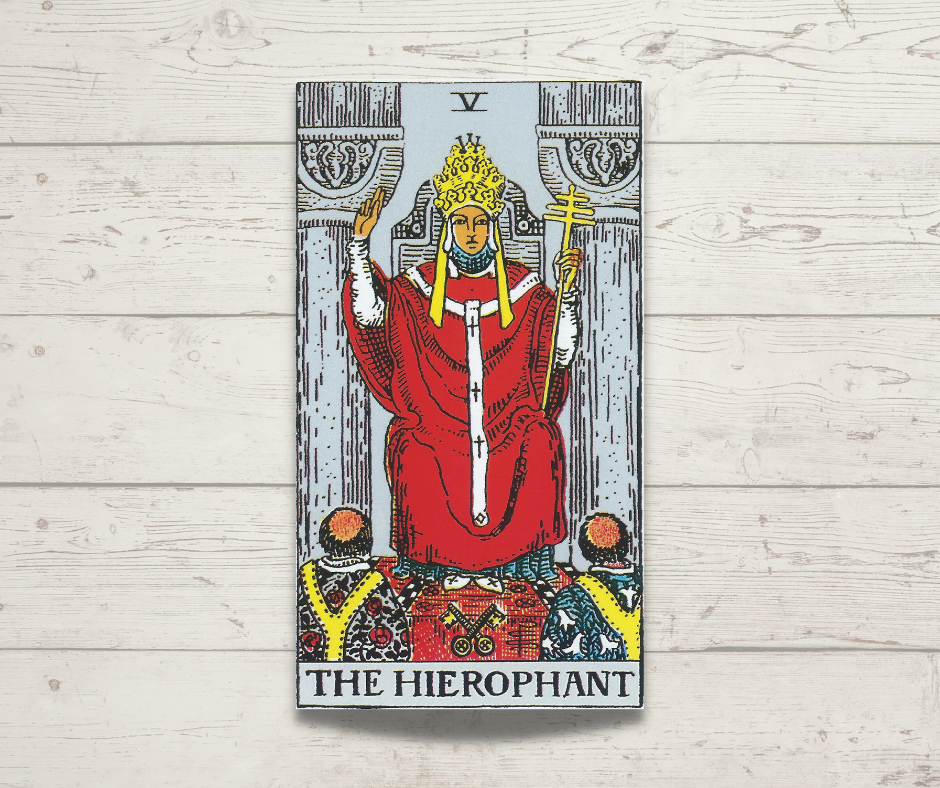
Connect with your inner teacher with my Hierpohant laser lesson.
Through journalling prompts, meditations, spreads, and resources you are guided toward a heartfelt resonance with your spiritual being. If you’re drawn to The Hierophant click the image to discover more and buy your laser lesson today.
The Hierophant observes the skillful use of traditional knowledge to facilitate personal transformation.
Yet, The Hierophant, like so many Tarot trumps, can be a paradox. There is a darker aspect to him, that is dogmatic and inflexible. Whilst he instructs that ritual can be very rewarding, and it often is when we are trying to ground ourselves. But, we are also warned about being too dogmatic. We can become entrenched in calcified beliefs. Stagnant and stale, we fail to move forward to keep in step with an evolving world. His challenge is to acquire a spirituality that truly reflects an integration of his own design and making.
One of The Hierophant’s most powerful aspects is his representation of faith.
He urges us to have faith in something. His paradoxical nature leans into the nature of faith and how it supports an ideology that might be a belief system but not a divine connection. He also advises that faith has to be renewable, it has to breathe. Having faith in the old vanguard borders on nostalgia as it doesn’t have any face in the current moment.
Having faith in oneself and one’s ability to discern is a building block to trust. When we trust the universal laws and processes, when we trust our wisdom and intuition, we can afford the confidence to listen to our inner teacher and guide. It is then that we can say we have a spiritual connection and path.
Let’s continue the discussion in our Exploring Tarot Facebook group and share your thoughts on The Hierophant or even thoughts around TS Eliot’s poem with our tarot collective.