“I’ve seen women insist on cleaning everything in the house before they could sit down to write… and you know it’s a funny thing about house cleaning… it never comes to an end. Perfect way to stop a woman. A woman must be careful to not allow over-responsibility (or over-respectability) to steal her necessary creative rests, riffs, and raptures. She simply must put her foot down and say no to half of what she believes she “should” be doing. Art is not meant to be created in stolen moments only.“
– Clarissa Pinkola Estés, Women Who Run With the Wolves
I took part in a very interesting
conversation recently.
It was part of a presentation at the College of Psychic Studies Tarot weekend and the discussion was immensely thought-provoking. Something got triggered, something I had been aware of but not really actualised. Maybe because I accepted the notion of my position and without questioning marched onwards toward my destiny.
The idea of Tarot reading being largely held within the domestic domain is a fascinating one, especially as consultations are now ensconced within a more corporate setting, the Holistic industry is alive and well and possibly feminising the language that is used in the business world.
As I have probably mentioned before…
My Great grandmother, a miner’s wife in a mining village in the deepest, darkest south Yorkshire, read playing cards and read tea leaves. My Father tells the story that when a caller was coming to consult the cup, he had to go to the shop for a quarter of Mazawattee tea.
The Mazawattee Tea Company, founded in 1887 by the Densham family, was one of the most important and most advertised tea firms in Britain during the late 19th century. The leaf was favoured by scryers as it was large and flat and made identifiable patterns in the cup. As it happens my Grandfather read playing cards but he didn’t court clients as my Great grandmother did.
It was not unusual for women to hold such a position in the community.
Especially the working class communities, where life often hung in the balance, the thin line between life and death, marriage or spinsterhood, children and their futures. It was very human to seek out a forecast for the coming times. Yet, it must be said, that the scrying sittings were not always of a divinatory nature, coming for a sitting created an opportunity to chat and hear news and also to feel involved in a community in which the commonality was often hardship.
However, consulting tea leaves, coffee grinds and cards were not always within the cultural thrall of the working class. Aristocratic ladies took to the tea shops and coffee houses for a ‘salon’ and it could be presumed the overlying theme might be the speculative fortunes of the husband or the promise of marriage.

One thing that they all had in common.
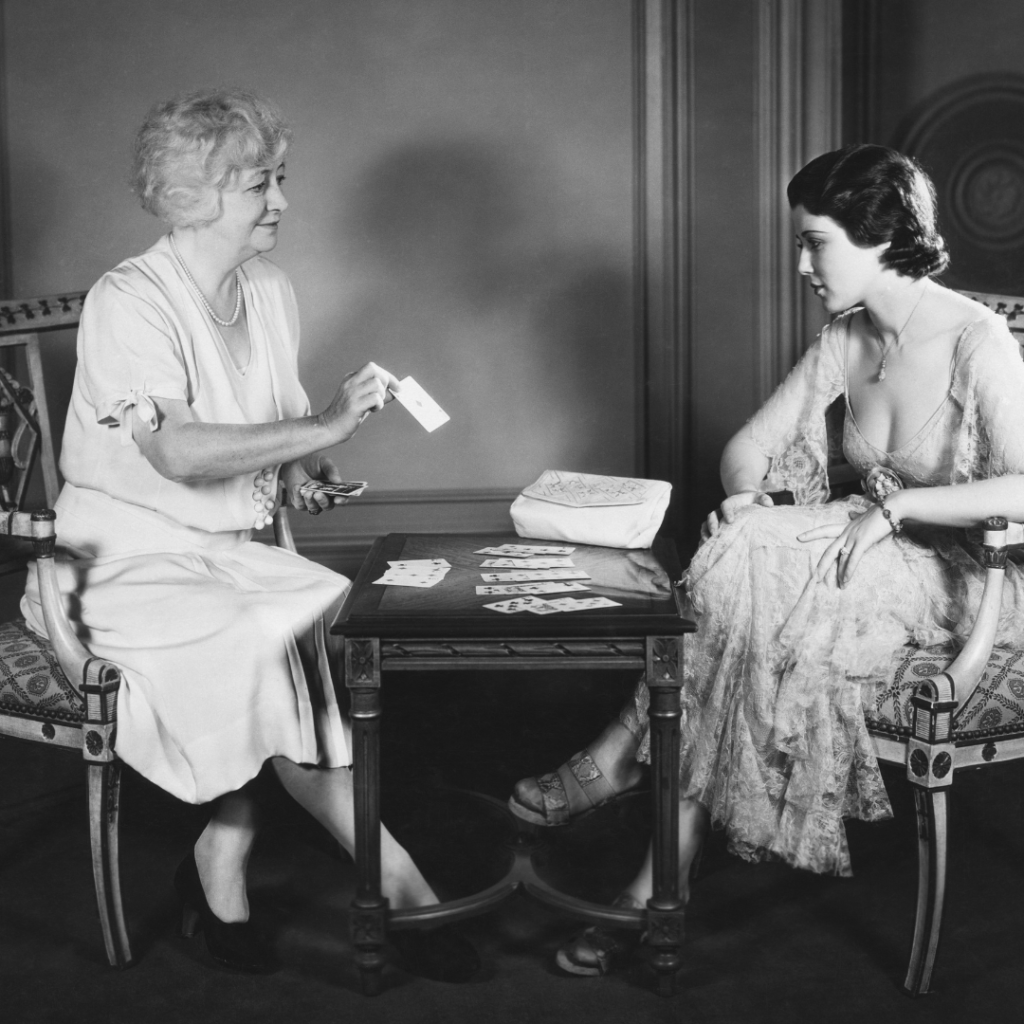
The proceedings were done in comfort, a cosy chair, conviviality, and a cup of something nice. No wonder Tarot fell largely into female territory, the domestic domain was the perfect theatre for consulting the oracle.
The Victorian era saw a surge of interest in Seances and spiritualism.
It must be noted that spiritualism made spiritual and speculative forecasting more available to men. Industrialists, philanthropists, and scientists all had a stake in the unfolding spiritualist movement.
Robert Owen was a proponent of spiritualism here in the UK, he was the founder of the CoOperative society, based in Keighley, Yorkshire. His regular business trips to America fuelled his interest. AE Wallace, and Arthur Conan Doyle, were other male notaries in this world of spirit as were some mediums, Daniel Douglas Home for example. But nevertheless, it was mainly women that provided the space and the ambience for a consultation into the world beyond.
Alex Owen, in her book, The Darkened Room, explores the role of gender in the world of seances and spiritualism and how it gave women the opportunity to earn money in their own right, beyond the limited patriarchal system AND in their own environment.
To this day, consultations are held within a home’s safe and welcoming interior.
As a neophyte, I would like to have friends, usually female, come by and have their cards read. Food and general felicitations would be part of the scenario as well as good old earthy questions about love, career, and family. Women are good at relationships. In nearly everything we do there is some kind of relationship involved, be it human, animal, mineral, or vegetable!
Again, it must be said that men are not
excluded here.
It is not that they pursue some kind of hagiography, but more that they think of the anima. Instead of being linear and straightforward, they are able to think more laterally. Reading cards is a very creative process and one which relies on the friendly interaction between imagination and intuition, often regarded as a feminine guile.
Tarot reading is not purely a feminist pursuit as such.
Whilst it is enriching to engage with the female deities and goddess cultures often depicted in the cards, one has to be careful that the reading doesn’t become limited or entrenched in a feminine culture that excludes other streams of consciousness.
In the 80s we saw Tarot decks such as Mother Peace and Daughters of the moon, they reflected the mores of that period and the emergence from an overtly misogynistic and chauvinistic society and were a welcome catalyst for a philosophical approach to how one lived.
Authors such as Gail Fairfield in her book Choice Centred Tarot were also part of that era and posed psychological interpretations, aimed at women’s issues. There was a whole moment when the spiritual field could have been politicised. Arguably, wherever there is spirituality there is a Politik.
Now Tarot reading has become commercialised.
Everything from decks, reading paraphernalia, books, and consultants has grown exponentially. It is a growth industry and where it was once shunned by mainstream corporate businesses. Even they have succumbed to partaking in some form of service offered by the Holistic field, whether it is lunchtime meditations, Reiki sessions, intuitive team games, or board room shamanism, the art of spiritual consultancy is no longer relegated to the denizen of Violets and old lace.
These days one needs insurance and we are held by consumer laws. The language used in business parlance when a transaction takes place is no longer harsh, such as granular or drilling down. Instead, it is deep diving or earthy!
Old habits die hard.
We still love the homely ambience, whether it is a front room or an office suite. Some people go for candles and crystals, others for large cushions and bright colours.
A lot of work happens via Zoom or teams. With clever interactive work, you can still make it a nice atmosphere but one where the imagination takes the job of an architect. Stirring the cooking pot whilst considering the spiritual lily is very much a part of a consultation, be it the lounge, office, or Zoom room.
The most important thing is the great work and our capacity to be of
compassionate service.